


Brightening / Melasma / Redness / Blemishes[Targeting only bothersome lentigo] Lentigo Laser
![[Targeting only bothersome lentigo] Lentigo Laser](/_next/image?url=https%3A%2F%2Ffirebasestorage.googleapis.com%2Fv0%2Fb%2Fkkeutguro-7e583.firebasestorage.app%2Fo%2Fproducts%252Fguro%252Fen%252F1758789693757_edd8536b-54b2-4787-9959-00922c26ceb2_004-ezgif.com-png-to-webp-converter__1_.webp%3Falt%3Dmedia%26token%3D34c92d1c-9de4-4ec5-85ac-76e946c050e3&w=2048&q=75)
[Targeting only bothersome lentigo] Lentigo Laser
Lentigo is a pigmented skin condition caused by the localized accumulation of melanin pigment. This laser treatment selectively manages the noticeable areas. The burden on daily life is relatively low. *VAT excluded
Options
Treatment Details




Feature 1. Laser treatment that precisely targets and improves pigmentation
Delicate Treatment Approach for Lentigo Improvement
755nm Alexandrite Laser with High Melanin Absorption Efficiency and Appropriate Skin Penetration Depth
We use a laser to precisely target and treat dark, prominent lentigo areas, helping to improve them.
If necessary, Er:YAG Erbium YAG
laser is used in combination to delicately manage even faint remaining pigmentation on the surface. Improvement can usually be expected after 2-3 sessions, but results may vary individually. Unnecessary repeated
treatments are avoided; instead, we aim for improvement within a reasonable number of sessions based on thorough diagnosis and planning.
Our efforts for lentigo improvement continue consistently.
Feature 2. A Meticulous Approach to Treatment
We prioritize the quality of treatment, limiting the number of patients seen by each medical staff member per day. This involves adjusting the daily appointment capacity to be relatively low,
a choice made to allow us to focus more deeply on each patient and dedicate ample time to them.
This policy ensures ample time throughout the entire process, from consultation to treatment and post-care,
allowing for detailed explanations and customized plan development, as well as the ability to closely observe and respond to the patient's skin condition and reactions.
This secures time to enhance treatment precision and improve patient satisfaction. Beyond simple
repetitive care, we provide meticulous treatment. We invest sufficient time to sincerely focus on each patient's
skin concerns.
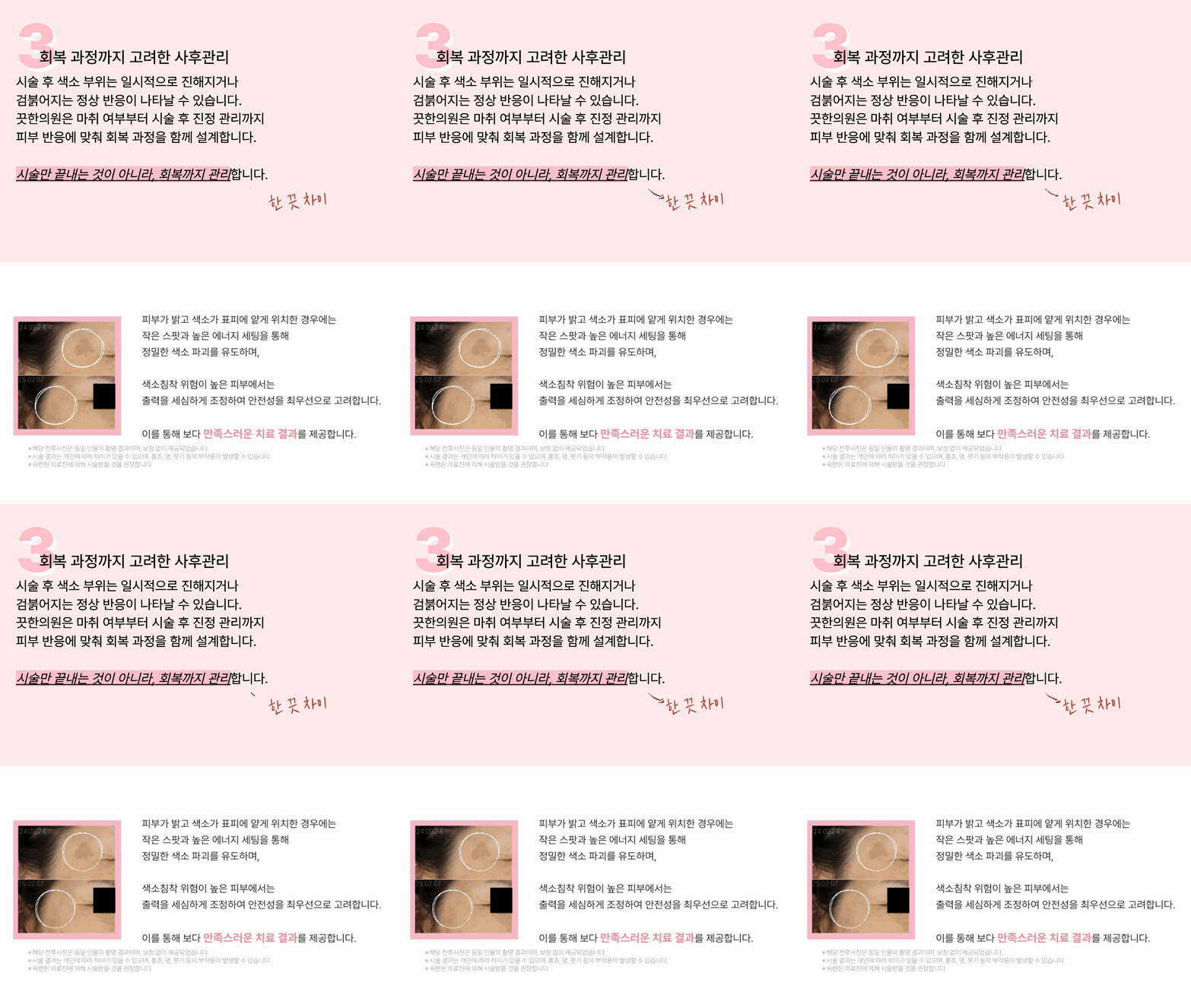
Feature 3. Individualized Laser Settings
We carefully consider skin tone, lesion size, depth, and skin reactivity to adjust spot size, pulse energy, and fluence values.
For instance, for individuals with fair skin and light pigmentation,
we meticulously irradiate with a precise spot size and energy suitable for targeting the lesion,
while for darker skin tones or sensitive skin where hyperpigmentation is a concern, we proceed with fine-tuned power adjustments to ensure safety during the procedure.
These detailed customized settings are a crucial factor that can affect the precision of treatment outcomes, even when using the same laser equipment.
Feature 4. Systematic Skin Recovery Management After Treatment
The 755nm Alexandrite laser is excellent in pigment destruction efficiency. After treatment, temporary redness may occasionally appear or
the treated area's pigmentation may temporarily appear darker red. Therefore, systematic skin regeneration management and thorough UV protection are important.
Furthermore, since patients have different sensitivities to pain during 755nm and Er:YAG laser treatments,
we comfortably determine whether to apply anesthetic cream after a preliminary consultation.
After the treatment, we perform cooling care and soothing management using Jauungo modeling packs to calm irritated skin.
We also provide genuine Duoderm and guide patients on its use to aid smooth recovery and protect against UV rays when going out.
Feature 5. Treatment Plan Considering Overall Pigmentation Concerns, Not Just Lentigo
Many patients who come for lentigo removal also have complex dermal pigmentation such as melasma, in addition to lentigo. While removing only lentigo is one approach, many people prefer the entire face's
uneven pigmentation concerns to be improved together.
We conduct in-depth consultations with patients using diagnostic equipment to accurately analyze facial pigmentation. Afterwards, we collaboratively decide on the direction of treatment, whether to focus on epidermal pigmentation or to consider the overall pigment harmony
for a comprehensive treatment. This helps to achieve more balanced skin improvement.
Why Do Lentigines Occur?
Solar lentigines (sunspots) are brown, flat pigmented lesions primarily associated with UV exposure and skin aging.
They occur when melanocytes become overactive, leading to excessive pigment deposition in specific areas.
Continuous exposure to UV rays leads to ongoing melanin production, and as one ages,
the skin's regenerative capacity and pigment metabolism decline, causing lentigines to gradually darken and spread. They commonly appear on exposed areas like the face, back of the hands, and arms, typically having distinct
borders and a dark brown color.
Areas Where Lentigines Appear
Lentigines (solar lentigines) typically
are primarily observed in the skin's epidermal layer (Epidermis),
especially when melanocytes in the basal layer (Basal layer) overproduce pigment due to UV exposure,
and these melanin pigments accumulate in specific areas, forming lesions. Histologically, lentigines do not penetrate deep into the dermal layer; instead, melanin is excessively
accumulated within the epidermal layer. The borders with surrounding normal skin are relatively distinct.
Due to these characteristics, 755nm, which is suitable for targeting epidermal and upper dermal pigment,
shows characteristics that suggest a good response to long-pulsed Alexandrite laser treatment. Therefore, treatments for deep dermal
melasma or complex pigmented lesions, which affect deeper areas, require a different approach when planning treatment.
Key Features of 755nm Laser
The 755nm wavelength effectively reacts with melanin pigment and is an Alexandrite laser wavelength that reaches a relatively stable depth, encompassing the entire epidermal layer and the upper dermal layer.
The 755nm laser, delivered in a long-pulsed manner, can be delicately controlled in millisecond (ms) units to deliver high energy to pigmented lesions. Melanin pigment selectively absorbs this light energy, converts it into thermal energy, and then,
breaks down the pigment particles into tiny fragments. Some of the fragmented pigment, following the natural metabolic process of the skin surface,
can be finely shed with dead skin cells according to the skin's turnover cycle. The remaining pigment is absorbed by macrophages in the body
and goes through a process of elimination. As these destroyed pigment particles gradually disappear, the lentigo lesions can be visibly lightened or
faded.
Approach to Lentigo Removal Treatment
The 755nm Alexandrite laser can be suitably utilized to improve lentigo lesions.
However, achieving successful treatment results goes beyond merely using good equipment. When accompanied by precise skin diagnosis, customized settings for each patient, and a systematic post-treatment care program,
more satisfactory improvement can be expected.
Procedure Process
첫 상담부터 마무리까지의 실제 진행 순서를 확인하세요.
- 01
Personal Cleansing
- 02
Skin Condition Analysis using Mark-Vu Device
- 03
Individualized Consultation
- 04
Laser Parameter Setting and Procedure Progress tailored to Individual Skin
- 05
Soothing and Finishing Care (Application of Regenerative Cream)
시술 기본정보
시술 시간, 마취, 회복, 유지기간을 한 번에 확인하세요.
TIME
10-15 minutes per area
ANESTHESIA
No anesthesia
RECOVERY
Immediate return to daily life
Ideal For
One Fine Difference makes real results.
- KKEUT POINT 01
Some individuals have partially lightened lentigines from previous laser treatments, but require more significant improvement.
- KKEUT POINT 02
Recommended for those who desire noticeable improvement in pigmented lesions in a relatively short period.
Q&A
고객님들이 가장 많이 물어보시는 내용을 모았습니다.
What is the treatment cycle?

Generally, it is recommended to perform treatments at intervals of about 3 to 4 weeks, considering the skin regeneration cycle and melanin pigment response.
How many sessions are typically needed for lentigo removal?
Based on 755nm wavelength laser treatment, many cases can expect improvement in lentigo with 1 to 2 sessions. However, depending on individual skin type, the depth or area of the lentigo, and regular UV exposure habits, 2 to 3 additional sessions may be required. It is best to confirm detailed information through consultation.
Cautions
Results = Treatment × Aftercare. Please follow the notes below.
After the procedure, it is recommended to meticulously apply sunscreen to prevent potential hyperpigmentation and to avoid direct exposure to strong sunlight.
Refrain from using exfoliating products that may irritate the skin for about one week after the procedure.
For about one week after the procedure, refraining from alcohol, smoking, saunas, and strenuous exercise will aid in recovery.